

Traceable engineering evidence
Relevant technical material is connected to the analysis so that claims can be reviewed rather than treated as unsupported answers.
RIE-E turns complex engineering challenges into traceable, evidence-based analysis by connecting technical evidence, engineering reasoning, review and decision support.
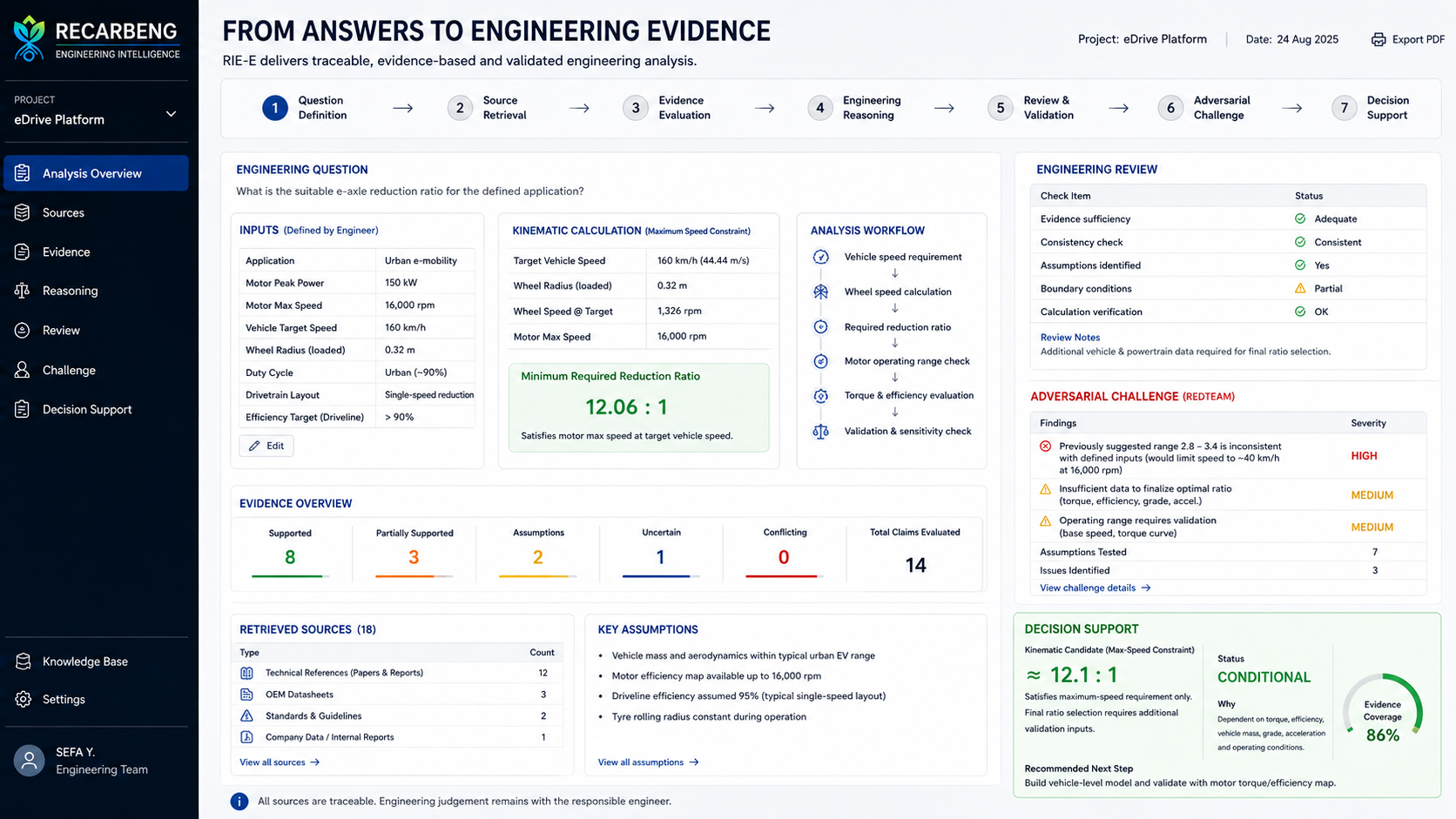
RIE-E is designed around the engineering work behind a conclusion: defining the problem, retrieving relevant evidence, evaluating support and assumptions, reasoning through trade-offs, reviewing limitations and identifying what still needs validation.
Relevant technical material is connected to the analysis so that claims can be reviewed rather than treated as unsupported answers.
The analysis makes assumptions, operating conditions and engineering trade-offs visible instead of reducing the problem to a single unexplained number.
Where evidence is incomplete or boundaries remain unresolved, the output stays conditional and identifies the next validation requirement.
RIE-E is designed to improve the quality, speed and continuity of engineering decisions by bringing evidence, customer context and engineering reasoning into one structured analysis workflow.
Move from fragmented technical information to structured engineering analysis and clearer decision support.
See assumptions, evidence gaps, contradictions and unresolved boundaries before they become hidden decision risks.
Identify missing evidence and validation requirements earlier in the engineering process.
Turn structured analysis and project learning into knowledge that can support future engineering work.
RIE-E is designed to bring customer-specific requirements, operating knowledge and engineering experience together with relevant external evidence and RecarbEng engineering expertise — creating analysis grounded in the customer's real engineering context.
RIE-E is designed to support these outcomes. Actual value depends on the engineering problem, evidence base, workflow and implementation context.
Engineering intelligence creates value when it improves the quality, speed and continuity of engineering decisions.
Move from fragmented technical information to structured engineering analysis and decision support.
See assumptions, evidence gaps, contradictions and unresolved boundaries before they become hidden decision risks.
Identify missing evidence and validation requirements earlier in the engineering process.
Turn structured analysis and project learning into knowledge that can support future engineering work.
RIE-E is designed to bring customer-specific engineering context together with relevant external evidence and RecarbEng engineering knowledge, so analysis is grounded in the customer's real engineering environment.
RIE-E is designed to keep customer-specific engineering knowledge within its defined customer context and not treat it as a shared knowledge asset across customers. Access, provenance and knowledge-use boundaries are defined according to the engagement and applicable confidentiality requirements.
RIE-E is designed for engineering work where evidence, technical context, trade-offs and validation requirements materially affect the decision.
RIE-E is designed not to force a conclusion when the available evidence is insufficient or conflicting.
Missing evidence and unresolved assumptions remain visible rather than being hidden behind a definitive answer.
Conflicting sources are surfaced for review rather than silently reduced to a single unsupported conclusion.
Boundary conditions and validation requirements are identified as the next engineering step.
RIE-E can identify what should be investigated, tested, validated or decided next. It supports the engineering process without replacing responsible engineering judgment or physical validation.
The visible workflow is intentionally simple. The underlying system evaluates evidence, assumptions, consistency and unresolved issues before producing decision support.
A generic answer can look precise without making its evidence, assumptions or limitations visible. RIE-E is designed to expose those elements and keep the result conditional where the engineering evidence requires it.
It identifies unresolved assumptions, missing evidence and boundary conditions, and indicates what requires further engineering validation.
We can explore how RecarbEng Intelligence can support a technical problem, assessment or decision where evidence, engineering reasoning and validation matter.